
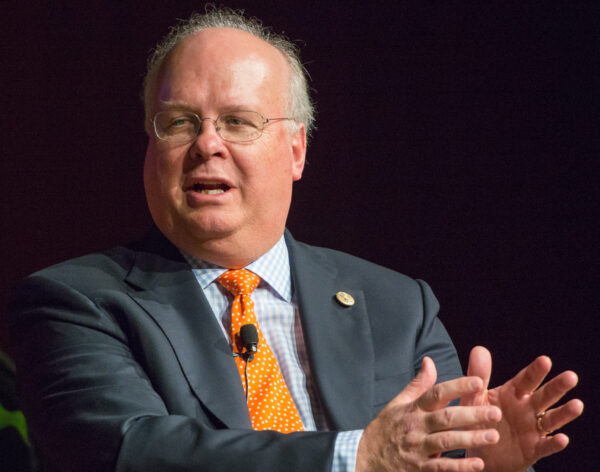
Veteran Republican strategist Karl Rove reportedly said over the weekend that President Donald Trump faces a significant messaging challenge when it comes to the ongoing U.S. conflict with Iran, arguing that the administration has not had enough time to fully make its case to the American people.
Speaking during a segment on Fox News with host Paul Gigot, Rove was asked to evaluate the administration’s rhetoric surrounding the war.
“How do you rate this administration’s rhetoric on the war?” Gigot asked.
Rove responded bluntly.
“Well, insufficient, and that’s timing,” he said.
The longtime GOP operative pointed to the contrast between the current situation and the lengthy buildup that preceded the 2003 war in Iraq. According to Rove, the Bush administration spent months preparing the public and the international community before military action was taken.
“We had, you remember the last few months of 2001 and virtually all of 2002 in order to make the case that action was needed against Iraq,” Rove said.
He noted that the process included debates at the United Nations, a U.N. resolution, and an authorization for the use of force passed by Congress. That lengthy process, he argued, allowed leaders to slowly present their arguments and explain the rationale for military action.
“We were able to consciously, deliberately, and over a long course of time to lay out the case,” he said.
Rove suggested that Trump did not have the same opportunity in the current conflict with Iran. According to him, the president decided to act quickly based on his belief that action was necessary to resolve the situation.
“The president took action because he felt he needed to take action, driven by a desire to end this problem once and for all,” Rove explained.
Because of that rapid decision, Rove said the administration has not had the chance to clearly outline its strategy or message to the American public.
“And so he hasn’t had the time to do the run up to this, in terms of laying out a plan and laying out a message to the American people,” he said. “And it shows in all the polling.”
Rove pointed to several public opinion surveys that suggest the president’s approach to Iran is facing skepticism from voters.
“Virtually every poll shows that the American people are unsupportive of the action that he is taking in Iran,” Rove said.
Still, he noted that the details of those polls reveal a more complicated picture.
Rove compared findings from two different surveys — one conducted by Fox News and another by Quinnipiac University — arguing that the way questions are asked can significantly influence how respondents answer.
The Fox poll asked whether voters approve or disapprove of the current U.S. military action against Iran. According to Rove, that survey found that 50 percent approve.
The Quinnipiac poll, however, asked questions in a different order.
One question asked respondents whether they approve or disapprove of how Trump is handling the situation with Iran. In that case, only 38 percent approved.
A separate question asked whether voters support or oppose U.S. military action against Iran, with 40 percent expressing support.
Rove suggested that linking the question directly to Trump affects how people respond.
“So by asking this question, ‘Do you approve of Donald Trump?’ before you ask, ‘Do you approve of the action being taken there?’ it causes people who don’t like Donald Trump to flip,” he said.
He pointed to the partisan divide in the results, noting that relatively few Democrats support the president’s handling of the issue.
“Twenty percent of Democrats agree with this first proposition,” Rove said, adding that the numbers drop further depending on how the question is framed.
Independents also appear divided, he noted, with support shifting depending on whether the question focuses on Trump personally or on the military operation itself.
“Independents, 40 percent agree with this, 29 percent agree with this, but it pops back up to 37 when you put it back on, do you approve of what the military is doing,” Rove explained.
In the end, Rove argued that the president faces a difficult political reality.
“Unfortunately, for the president, he’s stuck,” Rove said. “If it’s Donald Trump doing it, there are going to be few Democrats who approve, and a lot of independents who don’t.”
[READ MORE: Cuba Confirms Quiet Talks With Trump Administration Amid “Friendly Takeover” Rhetoric]