

President Donald Trump delivered a blunt message to Iran on Friday, declaring the regime has “no cards” as the United States prepares to enter critical negotiations aimed at ending the ongoing conflict between the two adversaries.
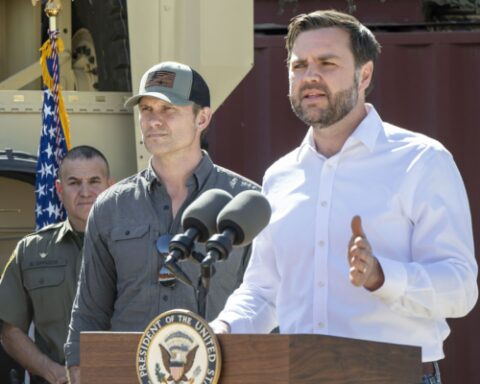
In a series of posts on Truth Social, Trump made clear that his administration intends to approach the talks from a position of strength. The negotiations are set to begin this weekend, with Vice President JD Vance scheduled to arrive in Pakistan as part of the diplomatic effort.
“The Iranians don’t seem to realize they have no cards, other than a short term extortion of the World by using International Waterways,” Trump wrote. “The only reason they are alive today is to negotiate!”
The remarks underscore a hardline posture that has defined Trump’s messaging throughout the conflict. While projecting confidence, the rhetoric also reflects the high stakes surrounding negotiations that could determine whether the violence escalates further or moves toward a resolution.
Trump followed up with another pointed critique, arguing that Iran’s strengths lie more in messaging than in military capability. “The Iranians are better at handling the Fake News Media, and ‘Public Relations,’ than they are at fighting!” he added.
These comments are the latest in a string of forceful statements from the president. Over the weekend, Trump issued a dramatic warning tied to the strategic Strait of Hormuz, a critical global shipping route. In a fiery post, he threatened severe consequences if Iran failed to reopen the waterway, using unusually sharp language to emphasize the urgency of the situation.
He escalated further on Tuesday morning, warning that failure to reach an agreement by a set deadline could result in the destruction of a “whole civilization.” The stark language drew attention not only for its intensity but also for what it suggested about the potential scale of the conflict if diplomacy were to collapse.
Despite the heated rhetoric, Trump later announced that an eleventh-hour agreement had been reached, calling it a “big day for World Peace!” The sudden shift from brinkmanship to celebration highlighted the unpredictable nature of the standoff, where moments of escalation are quickly followed by efforts to de-escalate.
Still, the president’s comments Friday suggest that tensions remain high as formal negotiations approach. His insistence that Iran lacks leverage echoes a similar message he delivered in a previous high-profile exchange with Ukrainian President Volodymyr Zelensky.
“Let me tell you, you don’t have the cards,” Trump told Zelensky during a contentious Oval Office meeting last year. “With us, you have the cards. But without us, you don’t have any cards.”
That same framing now appears central to the administration’s approach with Iran, emphasizing American leverage while downplaying the opponent’s position.
As talks loom, the contrast between aggressive rhetoric and the stated goal of peace raises familiar questions. While strong language may be intended to force concessions, it also serves as a reminder of how quickly conflicts can spiral. For now, the administration is betting that pressure, not prolonged fighting, will bring results—an outcome that could spare both sides from the deeper costs of war if diplomacy ultimately holds.