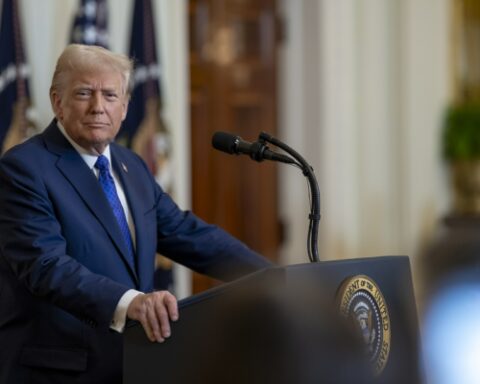

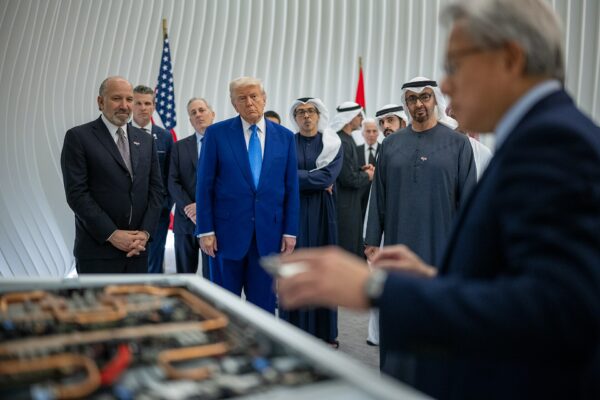
The strategy bluntly asserts that the United States is increasingly “at odds” with European officials, many of whom Trump says are clinging to unstable political coalitions and suppressing dissent while simultaneously demanding that Washington underwrite their preferred outcome in Ukraine. The document faults European governments for pushing peace terms that ignore battlefield realities and rely on the U.S. to guarantee Ukraine’s long-term security without offering clear commitments of their own.
The criticism comes as European leaders—including France’s Emmanuel Macron and Germany’s Friedrich Merz—continue urging Ukrainian President Volodymyr Zelensky not to accept any deal with Russia unless the U.S. provides ironclad security assurances. Trump’s strategy notes that European capitals have rejected aspects of his administration’s initial 28-point peace plan, which included limits on Ukraine’s military size and the removal of European peacekeeping forces from consideration.
A centerpiece of the new strategy is Trump’s call to end the idea of NATO as a “perpetually expanding alliance,” insisting that Europe must take “primary responsibility for its own defense.” This marks a sharp break not only from the Bush administration’s push to welcome Ukraine into NATO in 2008 but also from Trump’s own 2017 national-security strategy, crafted when establishment figures like H.R. McMaster, Jim Mattis, and Mike Pompeo held senior roles.
This strategy also departs dramatically from the Biden administration’s 2022 framework, which portrayed the world in ideological terms—democracies versus autocracies—and emphasized countering Russia’s “imperialist foreign policy.” Trump instead stresses the need to “reestablish strategic stability” with Moscow and positions Washington as a moderating force between Russia and a Europe that “faces civilizational erasure” due to uncontrolled illegal migration and the weakening of democratic norms.
The document echoes Vice President JD Vance’s critiques of European governments for curtailing free speech and undermining right-leaning political parties. It argues that Europe’s internal political dysfunction prevents leaders from delivering policies that reflect the public’s desire for peace and stability.
Some former officials reacted negatively, with Biden-era diplomat Jacqueline Ramos warning that adversaries will exploit any perceived split between Washington and Europe. But Trump’s team maintains that allies must show results of their own rather than rely on American leadership without accountability.
Looking ahead, Defense Secretary Pete Hegseth will soon release the Pentagon’s National Defense Strategy, which is expected to align closely with Trump’s vision. The president’s strategy calls for repositioning U.S. forces to prioritize the Western Hemisphere, explicitly promising to “reassert and enforce the Monroe Doctrine,” including targeted deployments and, when necessary, the use of lethal force to dismantle drug cartels.
The strategy also demands a stronger military posture in the Western Pacific to deter Chinese aggression, including denying Beijing any attempt to seize Taiwan and pressing allies to expand access for U.S. forces.
In contrast, Trump declares that the Middle East is no longer the center of U.S. foreign policy “as the U.S. steps up its energy production”—a significant shift even as Washington and its partners continue working to stabilize Gaza and assess Iran’s nuclear ambitions following a U.S. airstrike in June.
[READ MORE: Maersk Sees Rising India Demand as Trump Tariffs Pressure New Delhi Toward Trade Deal]