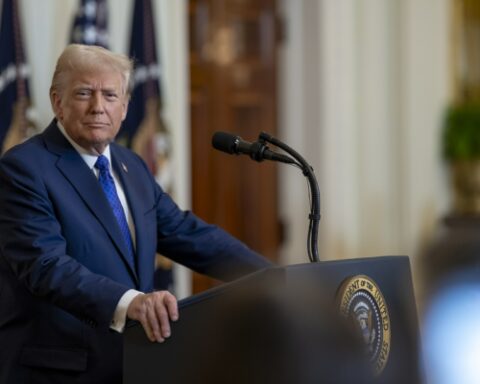

President Donald Trump reportedly signaled he may sideline Exxon Mobil from his sweeping plan to restructure Venezuela’s oil industry after the company’s chief executive publicly cast doubt on the proposal during a White House meeting.
The warning followed a high-level gathering at the White House on Friday, where Trump urged senior executives from across the U.S. oil sector to invest $100 billion in rebuilding Venezuela’s battered energy infrastructure. The president promised government-backed security guarantees for companies willing to participate, citing the recent U.S. operation that led to the capture of Venezuelan leader Nicolás Maduro as a turning point for stability in the country.
Speaking to reporters aboard Air Force One late Sunday, Trump was asked whether any oil companies had made concrete commitments following his pitch. The president initially declined to provide specifics, but quickly turned his attention to Exxon, making clear his frustration with the company’s response.
“I didn’t like Exxon’s response,” Trump said. “You know, we have so many that wanted – I’d probably be inclined to keep Exxon out. I didn’t like their response. They’re playing too cute.”
The remarks were a direct response to comments made days earlier by Exxon chief executive Darren Wood, who publicly questioned whether Venezuela is currently viable for large-scale investment. Speaking at the White House meeting, Wood described the country as “uninvestable” in its present condition.
Wood said Exxon would need to see “some pretty significant changes” before considering a return to Venezuela. He pointed to the need for reforms to commercial frameworks, the legal system, and hydrocarbon laws, along with what he described as durable protections for foreign capital. Despite his skepticism, Wood struck a cautious tone, saying Exxon would be willing to send a technical team to assess the state of Venezuela’s oil infrastructure if conditions improved.
Trump’s reaction made clear that such public hesitation was not well received. The president has framed his Venezuela plan as a historic opportunity for American energy companies, arguing that U.S. leadership and security guarantees would eliminate the risks that plagued investors in the past.
When pressed during the Air Force One gaggle about what those security guarantees would look like, Trump brushed aside concerns, saying American companies would be fully protected.
“We have guarantees that they’re going to be safe, that there’s going to be no problem and there won’t be,” Trump said. “There’s not going to be a problem. They had problems in the past because they didn’t have Trump as a president. They had stupid people.”
Venezuela’s history with foreign oil companies loomed large over the exchange. In 2007, the Venezuelan government seized assets belonging to Exxon and ConocoPhillips, leaving both firms with billions of dollars in unresolved arbitration claims. That legacy has made many investors cautious, even as Trump pushes for a rapid return of American capital under a new political reality.
Today, Chevron remains the only major U.S. oil company still operating in Venezuela. Trump has made clear he wants far broader participation, arguing that American companies are uniquely positioned to revive production, secure global energy supplies, and benefit from Venezuela’s vast reserves.
By publicly singling out Exxon, Trump underscored that cooperation with his vision comes with expectations. The message was unmistakable: companies willing to move quickly and confidently will have a seat at the table, while those seen as hesitating risk being left out of what the president has billed as one of the largest energy redevelopment efforts in modern history.
[READ MORE: Trump Touts U.S. Energy Power as American Oil Giants Move to Revive Venezuela]