
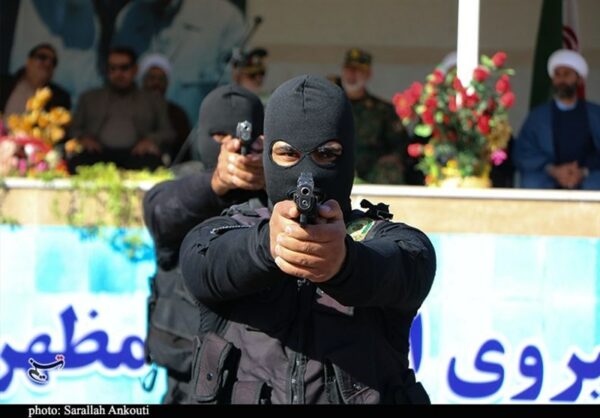
Iran’s government marked the anniversary of the 1979 Islamic Revolution on Wednesday with mass rallies across the country, projecting defiance at a moment when fragile nuclear negotiations with Washington hang in the balance and the threat of renewed regional conflict looms.
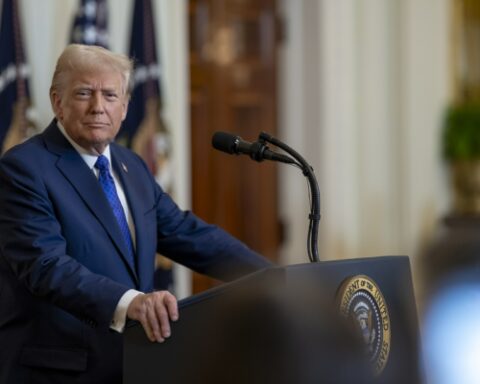
The annual event commemorates the overthrow of the shah and the rise of Iran’s clerical regime. This year’s celebrations unfolded under the watch of a U.S. naval buildup in the Persian Gulf ordered by President Donald Trump, who has made clear that military action remains an option if talks over Iran’s nuclear and military capabilities fail.
On Tuesday, Trump said he was considering sending a second aircraft carrier to the region. A fleet of warships is already positioned nearby, ready in the event negotiations collapse.
At the same time, Iran is grappling with internal unrest. Last month, antigovernment protests swept the country and were met with a fierce crackdown by security forces. Authorities crushed the demonstrations with deadly force, killing thousands. Arrests have continued in what appears to be a sweeping effort to silence dissent, including targeting figures linked to the reformist movement aligned with President Masoud Pezeshkian.
Speaking at Tehran’s Azadi Square, Pezeshkian acknowledged the turmoil, saying the situation had “caused great sorrow.” He expressed regret, stating, “We are ashamed before the people, and we are obligated to assist all those who were harmed in these incidents.”
“We are not seeking confrontation with the people,” he added.
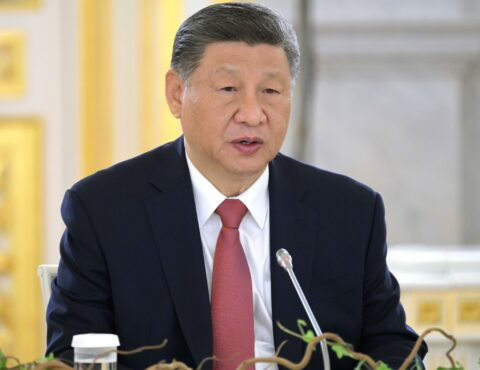
Still, Pezeshkian criticized what he described as Western propaganda, echoing Tehran’s claim that the unrest was orchestrated by the United States and Israel. He urged unity under Supreme Leader Ayatollah Ali Khamenei, who has ruled Iran for 37 years.
“We must stand united under the supreme leader’s guidance, heal the wounds of society, and confront external aggression with unity,” Pezeshkian said.
The divide within Iranian society was evident Tuesday night during fireworks marking the eve of the revolution’s anniversary. While government supporters chanted “God is great” from rooftops, videos verified by The New York Times also captured residents shouting “Death to Khamenei” and “Death to the dictator.”
Ellie Geranmayeh, an Iran expert at the European Council on Foreign Relations, said authorities would frame the anniversary as a “year of resistance and defiance to U.S. hegemony.” In Iran’s calendar, both the 12-day war initiated by Israel and briefly joined by American warships, as well as January’s protests, occurred within the current year.
“That hits at the heart of the foundations of the Islamic Republic,” Geranmayeh said, noting that the regime’s ideological base is rooted in the concept of confrontation with the United States.
Large crowds of government supporters filled Tehran’s streets, waving Iranian flags and chanting slogans including “death to America.” Some burned U.S. and Israeli flags and carried caricatures of Trump and Israeli Prime Minister Benjamin Netanyahu.
Netanyahu is scheduled to meet with Trump in Washington and is expected to advocate for a tougher approach toward Tehran. Trump told Israeli broadcaster Channel 12 on Tuesday, “Either we reach a deal or we’ll do something very tough.”
U.S. officials have said any agreement must freeze Iran’s nuclear program, eliminate its enriched uranium stockpile, curb ballistic missile range and end support for proxy militias. Iranian officials insist negotiations, which began last week in Oman, will focus solely on the nuclear program.
“We still do not have full trust in the Americans,” Foreign Minister Abbas Araghchi said in an interview with RT. “We were in the middle of negotiations last June when they decided to attack us.”
With no date set for the next round of talks, tensions remain high abroad and divisions deepen at home. Political scientist Morteza Nemati described Iran as “dangerously polarized,” warning that without negotiation between the government and opposition, “disaster is on the horizon.”
[READ MORE: Trump Administration Moves to Scrap Obama-Era Climate Finding in Major Deregulatory Push]