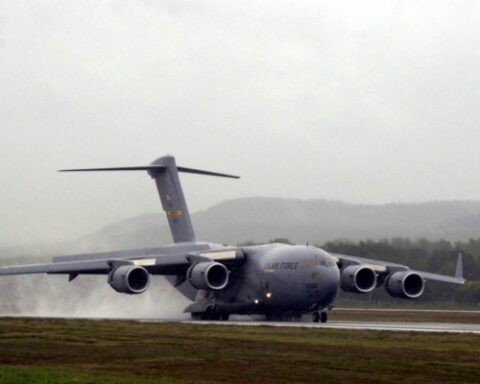


Questions continue to surround the retrofitted Qatari aircraft now serving as President Donald Trump’s temporary Air Force One, with aviation experts raising concerns over whether the aircraft received the full range of defensive systems and security upgrades typically expected for the commander in chief’s aircraft.
The discussion intensified after changes to the president’s transportation plans highlighted ongoing security concerns about whether the aircraft was sufficiently upgraded to protect the president during domestic and international travel.
Richard Aboulafia, a military aviation consultant, told The Hill that many of the aircraft’s capabilities remain classified, making it impossible to know precisely how it compares to the traditional Air Force One fleet. Even so, he argued that the time and money devoted to the retrofit suggest it likely falls short of the standard normally expected.
“We can’t say for sure because, of course, a lot of the systems and capabilities are classified,” Aboulafia said, adding that equipping an aircraft with the capabilities typically required for Air Force One generally takes significantly more time and funding than were devoted to the Qatari jet.
According to Aboulafia, a presidential aircraft normally requires self-defense systems, electronic countermeasures, chaff and flare dispensers, and other protective technologies designed to defend against potential threats. It also needs secure communications equipment capable of transmitting encrypted messages while in flight.
The cost of modifying the aircraft has also been the subject of debate.
Air Force Secretary Troy Meink told lawmakers during congressional testimony in June that estimates placing the retrofit cost at roughly $1 billion were too high.
“But a lot of those costs associated with that are costs that we’d have experienced anyway, we will just experience them early,” Meink said. “So, it wouldn’t be anywhere near that.”
Meink estimated that the retrofit itself likely cost less than $400 million.
Aboulafia, however, disputed whether that amount of money and the compressed schedule could realistically produce an aircraft comparable to the traditional Air Force One fleet.
“The idea that that amount of time and money would do the job is laughable,” he said.
Jeremiah Gertler, a senior adviser at AeroDynamic Advisory and senior analyst at Teal Group, expressed similar skepticism.
Gertler noted that the Qatari aircraft serves as a temporary “bridge” jet until the next-generation VC-25B presidential aircraft are completed.
“The short amount of time and comparatively small amount of money spent on the bridge jet suggests that it would be difficult for it to have anywhere near the same equipment aboard that the VC-25Bs will,” Gertler said.
He pointed to the lengthy and costly process Boeing is undertaking to build the new presidential aircraft from the ground up, arguing that the comparison indicates the bridge aircraft likely contains fewer systems.
“The Air Force acknowledged that some systems had been left off for simplicity,” Gertler added.
Florida-based defense contractor L3Harris Technologies completed the retrofit in fewer than 10 months using approximately 400 employees. Last month, the company said the aircraft now serves as an airborne command post equipped with a new communications system providing resilient and secure connectivity during global events.
Retrofitting an aircraft into Air Force One typically includes installing advanced communications equipment along with defensive technologies such as infrared countermeasures designed to confuse or defeat incoming missiles. Other modifications include creating a press cabin and ensuring the president has communications capabilities comparable to those available in the White House Situation Room.
“Flying Oval Office, really,” Gertler said.
It is widely believed that the older Air Force One aircraft also feature hardened wiring to protect against electromagnetic effects during a nuclear conflict, advanced missile defense systems, aerial refueling capability for extended flights, and an onboard medical suite.
When asked about the aircraft’s capabilities, an Air Force official declined to discuss them, referring questions to the White House. The Pentagon likewise directed inquiries to the White House.
White House Communications Director Steven Cheung defended the aircraft, describing it as “a state-of-the-art aircraft” equipped with “high-level security protocols” to protect the president and his staff.
Cheung added that, as President Trump has recently stated, numerous enemies have targeted him, and the administration uses “every tool at our disposal — including distraction and misdirection” to address those threats.
Trump unveiled the retrofitted aircraft last month at Joint Base Andrews in Maryland. The plane is intended to serve as a bridge between the aging Boeing 747-200 aircraft that have operated as Air Force One for more than two decades and the new VC-25B fleet, which is now expected to enter service in 2028 after originally being anticipated in 2024.
The president also changed the aircraft’s exterior paint scheme from the familiar two-tone blue design to one featuring dark navy blue, red, and gold.
Aboulafia suggested the aircraft reflects different priorities.
“I think the key to understanding this whole thing is less about what wasn’t done and more what was desired,” he said, adding that while the Air Force manages mission requirements and systems integration, “What doesn’t it do? Luxury.”
The aircraft has already completed two domestic trips to North Dakota and South Dakota and was also used for the president’s travel from Washington, D.C., to Turkey and later from the United Kingdom back to the United States.
During the flight departing Turkey, reporters aboard the aircraft were instructed to keep their window shades closed without initially being told why. When asked about the decision, Trump said it was probably because of the “sleazebags over here,” referring to Iran’s leadership. Iran shares a border with Turkey.
“Turkey’s in a dangerous neighborhood,” Aboulafia said. “Once again, missiles are flying, and once again, there are many hostile actors. This is serious stuff.”
[READ MORE: Trump Says He Left Instructions if Iran Carries Out Assassination Threat]