
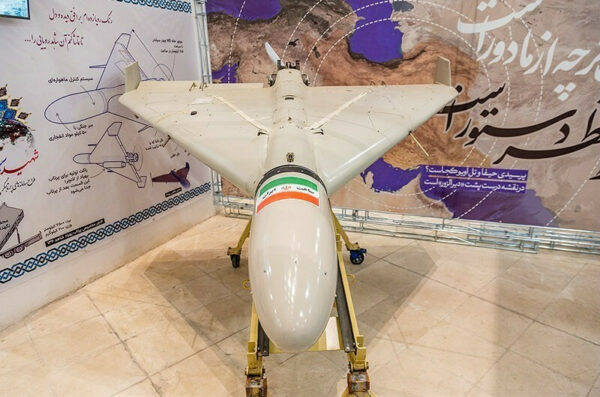
Iran’s newest suicide drone, the Hadid 110, is drawing attention for its combination of speed and stealth after being unveiled during the ongoing conflict, highlighting what Iranian officials portray as a major advance in the country’s domestically produced military technology.
The drone was first presented to then-Supreme Leader Ali Khamenei last year before he was killed in the opening strikes of the war.
Unlike many of Iran’s existing attack drones, which rely on propellers and travel at relatively slow speeds, the Hadid 110 is powered by a turbojet engine. Iranian sources say the aircraft can reach speeds of approximately 316 mph, making it the fastest-known drone produced by Iran.
The aircraft is launched using a solid-fuel booster that accelerates it to the necessary speed and altitude before the turbojet engine ignites. That system is designed to allow the drone to be deployed quickly from the field.
Its speed is considered one of its primary advantages.
Air defense systems depend on detecting an incoming threat, tracking its flight path, and launching interceptors before the target reaches its destination. A faster aircraft reduces the amount of time defenders have to complete that sequence.
According to the report, the Hadid 110 is intended to shorten that response window, allowing it to reach its target before defensive systems can react.
The drone also incorporates stealth-focused design features. Iranian experts describe it as having a seamless, boltless airframe intended to reduce its radar signature.
An S-shaped air intake positioned on top of the fuselage conceals the engine’s fan blades, while the aircraft’s exterior is coated with radar-absorbing material.
The Hadid 110 carries a 30-kilogram warhead, has a strike range of roughly 220 miles, and is capable of remaining airborne for about an hour. According to the report, those capabilities make it suitable for striking significant targets relatively close to Iran’s coastline, though it is not described as a long-range strategic weapon.
Iran maintains that the drone was built entirely within the country. The report notes that claim may or may not be accurate, pointing out that Iran has received support from both China and Russia during the conflict. Regardless, the assertion is presented as politically significant inside Iran, where domestic weapons production carries symbolic importance after years of sanctions limited access to advanced Western aircraft technology, engines, avionics, and materials.
The report also argues that each new weapons development affects Iran’s internal military structure.
Ballistic missiles and drones are controlled by the Islamic Revolutionary Guard Corps rather than the country’s regular military, meaning advances in those capabilities further strengthen the IRGC’s influence.
According to the report, the ongoing war has accelerated that shift in power. With Supreme Leader Ali Khamenei dead and his successor, Mojtaba Khamenei, not yet appearing publicly, authority has increasingly moved toward military commanders overseeing Iran’s missile and drone forces.
As a result, the report characterizes the unveiling of the Hadid 110 as more than a demonstration of military capability, describing it as a signal of the IRGC’s intentions.
The drone’s debut came as the conflict entered an unexpected lull. Following two weeks of escalating attacks, both sides have paused strikes despite no formal ceasefire being announced.
The report describes the situation as a fragile pause, noting that Iran has closed the Strait of Hormuz, pledged to expand the conflict, and rejected any suggestion that the United States should determine when fighting begins or ends.
Foreign Ministry spokesman Esmail Baghaei said Iran would continue defending itself “for as long as necessary” and declared, “We will not allow America to determine the timing of war and peace.”
Baghaei also confirmed that Iran and Oman are discussing management of shipping through the Strait of Hormuz without U.S. involvement while the waterway remains closed because of what he called “US-imposed insecurity.”
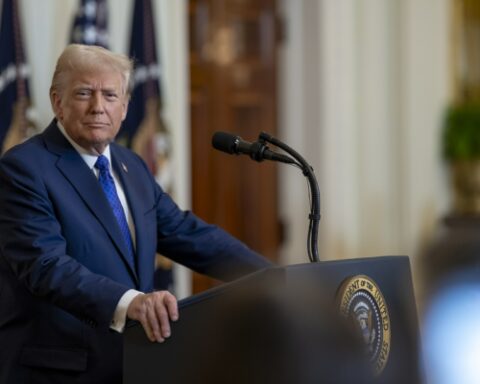
President Donald Trump, meanwhile, has said the current pause is intended to allow negotiations to resume. According to the report, he has also been informed that the United States is running low on interceptor missiles—the type of defensive weapon needed to counter threats such as the Hadid 110. For now, the pause in fighting continues.