
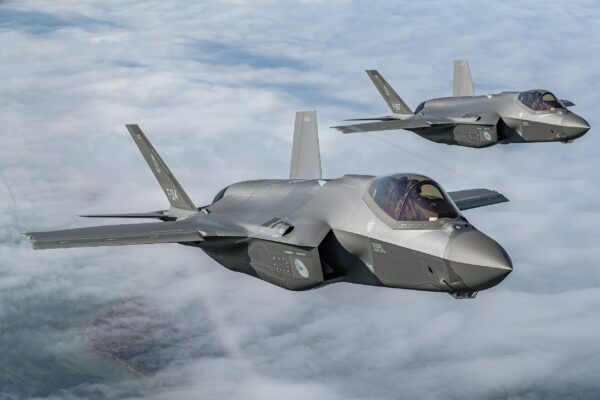
Canada is reassessing its planned purchase of U.S.-made F-35 fighter jets as escalating trade tensions between Washington and Ottawa spill over into what has become a sensitive flash point in the broader relationship between the two longtime allies.
Ottawa has already committed to buying at least 16 F-35A Lightning II fighter jets, the fifth-generation aircraft produced by Lockheed Martin. Canadian Prime Minister Mark Carney is also weighing whether to move forward with the purchase of an additional 72 aircraft. But a combination of domestic political pressure, rising costs, and an increasingly strained relationship with President Donald Trump has prompted Carney’s government to consider alternative defense suppliers.
Vincent Rigby, a former national security and intelligence adviser to ex–Prime Minister Justin Trudeau, said the increasingly sharp rhetoric coming from Washington has caused many Canadian policymakers to rethink the country’s defense relationship with the United States.
“We defend the North American continent very closely with the United States,” Rigby said, noting that shared security interests have long aligned. Still, he argued that recent actions and statements from Washington have put Canada in a difficult position, leading officials to explore options beyond American defense manufacturers.
Rigby said Ottawa is now considering diversifying its defense procurement, including purchasing more equipment from Europe, the Indo-Pacific region, and countries such as South Korea. He described that potential shift as a major departure from Canada’s long-standing reliance on U.S. defense systems.
Canada agreed in 2022 to purchase a total of 88 F-35 fighter jets, aircraft capable of penetrating adversary territory with limited detection, serving as advanced battle management platforms, and carrying long-range antiship missiles. But the deal has faced obstacles, including delivery delays and ballooning costs that have risen by more than $27 billion.
The debate intensified last month after U.S. Ambassador to Canada Pete Hoekstra suggested in an interview with CBC that if Canada does not follow through with the F-35 purchase, the North American Aerospace Defense Command, or NORAD, would need to be altered. Hoekstra said that could result in U.S. warplanes flying into Canadian airspace more frequently, comments that sparked confusion and concern about the stability of the joint defense partnership.
The State Department later moved to clarify Hoekstra’s remarks, saying he was not threatening to change the longstanding defense agreement, which dates back to 1957. Instead, officials said he was addressing how Canada’s F-35 purchase fits into broader efforts to modernize North American defense.
“If Canada decided to significantly reduce its investment in the F-35, that would create a significant gap in the defense structure of North America,” the State Department said, calling that conclusion common sense rather than a warning.
The department added that Hoekstra’s comments were taken out of context and framed to generate headlines rather than accurately reflect his views on NORAD and the role of the F-35 in continental defense.
Still, trade tensions between the two countries have continued to strain relations since Trump’s return to office. In March of last year, Carney initiated a formal review of the F-35 deal, a process that remains ongoing.
One former Canadian official told CBC that Hoekstra’s comments amounted to political pressure aimed at forcing Ottawa’s hand. Andrea Charron, director of the Centre for Defence and Security Studies at the University of Manitoba, said such pressure is unlikely to work.
As the review continues, the F-35 debate has become a symbol of broader uncertainty in U.S.-Canada relations, raising questions about how trade disputes and political friction could reshape one of the world’s closest defense partnerships.