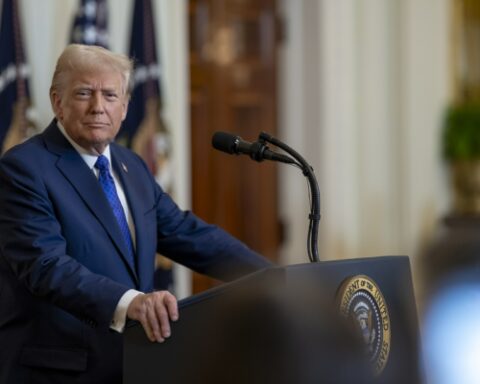

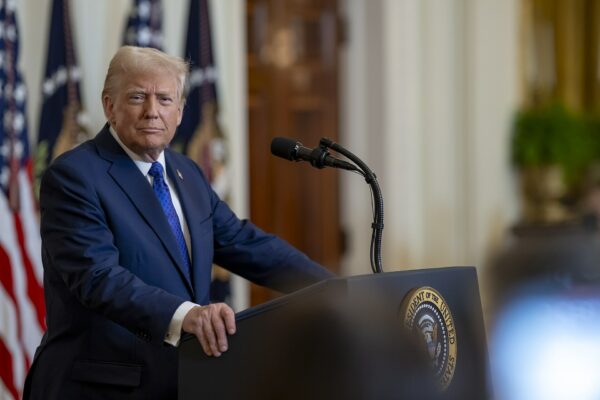
President Donald Trump used a Thursday morning appearance on Fox & Friends to defend the administration’s actions in Iran, criticize media coverage of the conflict, and reveal that taking control of Iran’s Kharg Island has long been his preferred approach to dealing with the Islamic Republic.
The interview came as fighting between the United States and Iran continued and debate intensified over the scope of America’s involvement in the conflict.
Trump began by expressing frustration with coverage of the war, singling out criticism from The Wall Street Journal.
“The Wall Street Journal, they did an editorial today about we’re not hitting them hard enough,” Trump told the hosts.
The president argued that recent military operations had already demonstrated substantial force.
“I mean, it is just, ‘not hitting them hard enough.’ We dropped $250 million worth of bombs on them last night. The whole thing is crazy,” Trump said.
He also claimed that Iran was in a weakened position despite continuing resistance.
“They’re really in submission. They just don’t know it yet, okay, to be honest with you. They just don’t know it yet,” he added.
Trump then turned to a strategy he said he has favored for years: taking Kharg Island, one of Iran’s most significant energy infrastructure hubs.
According to the president, the idea was not a recent development born out of the current conflict but rather a long-held preference he had discussed previously with Fox & Friends hosts Brian Kilmeade and Lawrence Jones.
“My preference has always been to take Kharg Island,” Trump said.
While describing the proposal as potentially beneficial, Trump also acknowledged uncertainty about whether Americans would support such a move.
“I don’t know that America has a stomach for it,” he said.
The president suggested that many Americans would prefer to see the country reduce its overseas commitments rather than expand them, even if he believes such a strategy could be advantageous.
“I think you’d like to see us come home,” Trump remarked.
He pointed to Venezuela as an example he believes has been successful, arguing that oil resources from that country have benefited American refineries.
Trump said he sees similarities between that situation and what could potentially be achieved regarding Kharg Island, but he repeatedly returned to the question of public support.
“I’m not sure the country has the appetite for it,” he said. “And that’s okay, I understand that.”
Discussion of Kharg Island has circulated in political and military circles for months. In late March, speculation increased that the Pentagon might be considering such a move after Trump ordered an additional 3,000 U.S. ground troops to the region.
At the time, some Republicans publicly advocated for the strategy. Among them was Sen. Lindsey Graham of South Carolina, who argued that taking control of the island could deprive Iran of a critical source of oil production.
During Thursday’s interview, Kilmeade praised Trump’s approach to the conflict, comparing it to a slow and deliberate effort to increase pressure on Iran while reducing its options.
Kilmeade pointed to recent military actions and described them as part of a broader strategy designed to weaken the Iranian government’s capabilities.
Trump largely agreed with the assessment before shifting the conversation toward domestic politics.
Responding to Kilmeade’s mention of the 2020 election, Trump reiterated his claims that the election had been rigged while arguing that he received more votes than any Republican candidate in history.
He then moved to discussing recent political developments in California, referencing Spencer Pratt and Steve Hilton. Trump claimed that public attention and criticism influenced decisions regarding election-related matters in the state.
The wide-ranging interview underscored both the continuing military conflict abroad and the domestic political battles that remain central to Trump’s public messaging, as debate continues over how far the United States should go in pursuing objectives overseas and what costs may accompany a prolonged confrontation.
[READ MORE: Trump Warns Iran of Consequences as Helicopter Incident Sparks New Round of Strikes]