
The Pentagon is now reportedly rolling out a new one-way attack drone to the Middle East — a low-cost, American-made system reverse-engineered from Iran’s notorious Shahed-136 — marking a major shift in U.S. military strategy under Defense Secretary Pete Hegseth’s push for cheap, fast-fielded unmanned weapons.
The move mirrors tactics long used by Iran, which has frequently recovered downed U.S. drones and copied their designs to build its own arsenal. Now the Pentagon is embracing the same playbook, adopting a crude but effective approach rather than relying solely on billion-dollar aircraft that take years to acquire.
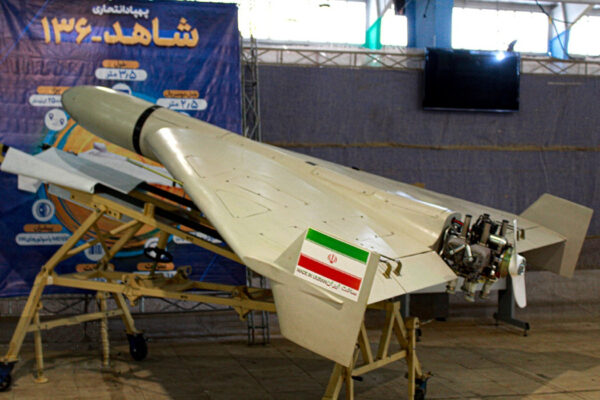
On Wednesday, the Defense Department announced Task Force Scorpion Strike, the first U.S. military unit in the Middle East dedicated to one-way attack drones. The drone — the FLM 136, also known as “Lucas” — is built by Arizona-based SpektreWorks and directly modeled after Iran’s Shahed-136, the very drone Tehran and its proxy militias have used to kill U.S. troops and strike American facilities.
Today @CENTCOM announced the first one-way attack drone squadron based outside of the U.S. A U.S. official tells me two dozen personnel from Task Force Scorpion Strike in an undisclosed country can employ one-way drones that have been reversed engineered from Iran's Shahed… pic.twitter.com/3XryiPdlbT
— Nick Schifrin (@nickschifrin) December 3, 2025
The decision comes nearly two years after an Iranian drone attack killed three U.S. soldiers at Tower 22, a remote U.S. outpost in Jordan — a stark reminder that Washington’s adversaries favor cheap, disposable systems that can overwhelm traditional defenses. Rather than continue relying exclusively on expensive MQ-9 Reapers and larger air platforms, Hegseth’s Drone Dominance initiative aims to flood the field with affordable, expendable drones that can be produced and deployed at scale.
Announced in July, Drone Dominance seeks to slash red tape, boost domestic drone manufacturing, and ensure that every Army squad has one-way attack drones by the end of fiscal year 2026.
SpektreWorks’ FLM 136 looks strikingly similar to the Iranian Shahed: a triangle-shaped drone with an 8-foot wingspan that can be launched from catapults, rocket-assisted takeoff systems, or mobile platforms. It is fully autonomous, relying on artificial intelligence and sensors to fly for roughly six hours and strike targets without constant human oversight.
Its price tag — $35,000 apiece — is a fraction of the $16 million cost of an MQ-9 Reaper, making it ideal for high-risk missions where losing a drone is expected. In some cases, they are cheaper than the missiles required to shoot them down.
Experts say the era of drone reverse-engineering is accelerating worldwide. “In the war in Ukraine, both sides have reverse-engineered each other’s drones,” said Caitlin Lee of RAND. Widely available commercial electronics have made building smaller, simpler drones far easier than copying high-end aircraft.
The new drone unit launches less than three months after U.S. Central Command created the Rapid Employment Joint Task Force — a fast-moving team led by CTO Joy Shanaberger — tasked with deploying new battlefield technology every 60 days by late 2026. One of the task force’s goals is to offset losses of costly MQ-9s with swarms of cheaper unmanned systems.
“Under current leadership… people are really starting to understand the necessity for being able to move at a pace that both technology as well as our adversaries move,” Shanaberger said.
With Iran, China, and Russia rapidly advancing their drone capabilities, the Pentagon’s new approach signals a major strategic pivot: meet cheap weapons with cheap weapons — but with American ingenuity and far greater scale.
[READ MORE: Netanyahu Signals Openness to Trump-Backed Israel–Syria Agreement — But Only if Security Buffer Zone Remains Intact]