
President Donald Trump delivered a blunt warning to Iran on Wednesday, declaring that the regime “will have to pay the price” as negotiations aimed at ending the conflict appeared increasingly strained following a new round of military exchanges between Washington and Tehran.
The president’s remarks came after the United States launched strikes against Iran in response to the downing of an American military helicopter near the Strait of Hormuz, an incident that quickly triggered retaliatory attacks from Iran and raised fresh questions about the future of ongoing peace talks.
“Iran’s Military is a complete and total mess,” Trump wrote on Truth Social.
“Much of it, like their Navy and Air Force, doesn’t even exist anymore – They have been completely defeated. Iran is all talk and no action. The Bully of the Middle East is DEAD!!! They’ve taken too long to negotiate a deal that would have been great for them, now they will have to pay the price!!!”
The sharp statement reflected growing frustration from the White House as negotiations that have been discussed for months remain unfinished despite repeated signs of progress.
Tensions escalated dramatically on Tuesday after an AH-64 Apache helicopter was shot down near the coast of Oman in the Strait of Hormuz. The incident immediately drew attention because of the strategic importance of the waterway and its central role in global energy markets.
According to U.S. officials, two American service members aboard the aircraft were successfully rescued and remain in stable condition.
Trump initially told the public that the crew members were “fine” and indicated that authorities were investigating exactly what had happened. Later Tuesday, however, the president directly blamed Iran for the incident and announced that the United States would be forced to respond.
U.S. Central Command subsequently confirmed that military action had been authorized.
According to Centcom, American forces “began launching self-defense strikes against Iran at 5 p.m. ET today at the Commander in Chief’s direction, in response to yesterday’s downing of a U.S. Army Apache helicopter.”
The confrontation did not end there.
Iran’s Islamic Revolutionary Guard Corps responded overnight by launching 21 attacks targeting American bases and other locations throughout the region. Despite the scale of the response described by Iranian officials, a U.S. official told The New York Times that all incoming missiles and drones were intercepted before reaching their targets.
The official said there was no reported damage to American military facilities.
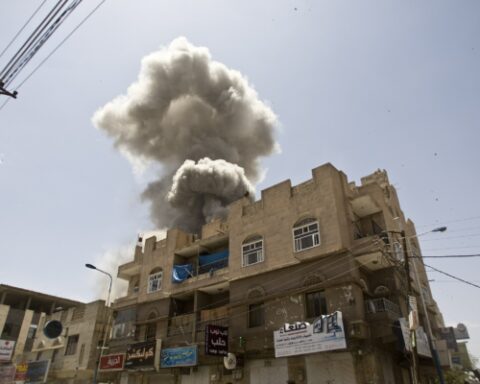
Iranian state media said the retaliatory operation was carried out in response to U.S. strikes near the Strait of Hormuz. According to those reports, the American attacks destroyed two water desalination plants located in the southern Hormozgan Province.
Even amid the exchange of strikes, diplomatic efforts have not completely collapsed.
Both governments have tentatively agreed to a memorandum of understanding that would end the conflict, reopen the Strait of Hormuz, and establish a framework for addressing the future of Iran’s nuclear program.
Still, public statements from both sides suggest that trust remains in short supply.
Iranian Parliament Speaker Mohammad Bagher Ghalibaf, one of the country’s leading negotiators, emphasized that Tehran still favors diplomacy while simultaneously warning against perceived violations of commitments.
“We prefer the language of diplomacy,” he wrote on X.
“Break your commitments, and we’ll switch to what we speak best. You ride the horse you saddled!”
For his part, Trump has continued expressing confidence that a deal remains within reach despite the violence.
Speaking with reporters early Tuesday, the president suggested the two sides could be just “two or three days” away from finalizing an agreement.
The optimism was consistent with comments Trump has made for months. According to Al Jazeera, the president has said since March that the United States and Iran were close to reaching a peace agreement on 37 separate occasions.
The latest military exchanges underscore the difficult reality facing negotiators. While leaders on both sides continue to speak about diplomacy, each new confrontation risks complicating efforts to secure the very agreement that both governments say they are pursuing.
[READ MORE: JD Vance Suggests Iran Talks May Be Reviving Despite Reports of Negotiation Freeze]