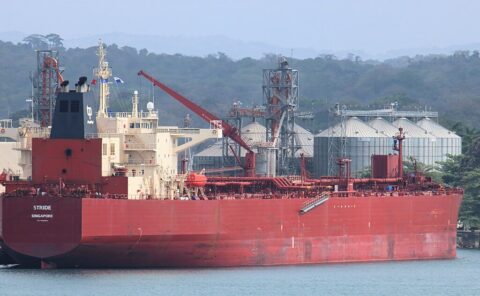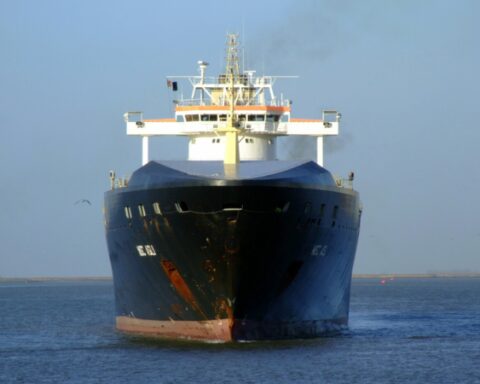

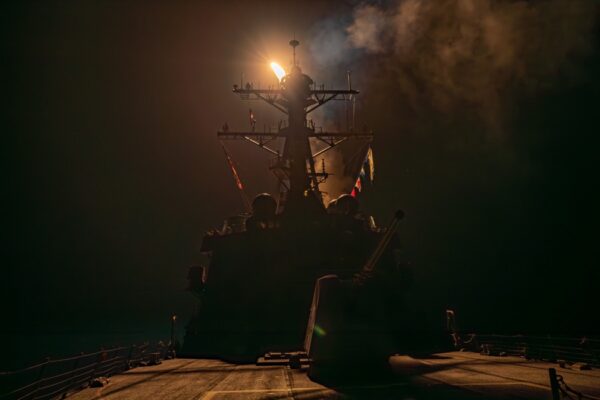
Iran’s joint military command issued a stern warning Thursday, declaring that any oil tanker traveling through the Strait of Hormuz must follow navigation routes approved by Tehran or face what it described as an “immediate and forceful response” from the country’s armed forces.
In a statement carried by Iranian state media, the Khatam al-Anbiya military command said vessels that fail to comply with Iran’s navigation protocols risk jeopardizing their own security.
“Any failure to comply, deviation from the designated route, or disregard for the navigation protocols of the Islamic Republic of Iran in the Strait of Hormuz will be met with an immediate and forceful response from the armed forces, endangering the security of the violating vessels,” the statement said.
The military command also warned that any action it considers disruptive within the strategic waterway would be viewed as a threat to Iran’s national sovereignty and would trigger what it called a “rapid and decisive action.”
Iran did not specify what prompted the warning. However, Iranian Deputy Foreign Minister for Legal Aid and International Affairs Kazem Gharibabadi appeared to reject any suggestion that outside military forces have authority over navigation in the strait.
His comments came after U.S. Central Command (CENTCOM) announced that military leaders from across the Middle East, including officials from Lebanon and Syria, met in Bahrain on Wednesday. According to CENTCOM, the meeting emphasized a shared commitment to ensuring the free flow of commerce through the Strait of Hormuz.
Gharibabadi pushed back against that position in a post on X, arguing that Iran alone determines navigation routes through the strategically important passage.
“Hormuz is defined under Iran’s command, not CENTCOM,” he wrote in a post translated from Persian. “A military summit in Bahrain cannot establish legal order and security for the Persian Gulf.”
Despite the renewed rhetoric from Tehran, commercial shipping activity through the Strait of Hormuz has begun recovering following last weekend’s exchange of military strikes between the United States and Iran. The conflict briefly threatened ongoing peace negotiations before both sides halted military operations.
According to maritime tracking firm Kpler, the number of vessel crossings climbed to 45 by Wednesday, an increase from 34 recorded the previous day.
Kpler reported that most ships favored the Omani route through the waterway, accounting for 21 crossings. Another 11 vessels traveled via the Iranian route, while the remaining traffic used either dark or unknown routes or those designated by the International Maritime Organization.
The reopening of the Strait of Hormuz has been a central element of the memorandum of understanding signed by the United States and Iran. Restoring traffic through the waterway—which carries nearly one-fifth of the world’s oil supply—was intended to help lower fuel prices after the strait’s closure during the war that began in late February contributed to rising energy costs.
Gasoline prices have fallen from highs above $4.50 per gallon in May. Even so, President Donald Trump has continued pressing fuel companies to reduce prices further, warning earlier this week against price gouging and saying that otherwise “big problems lie ahead.”
In a Truth Social post Thursday, Trump acknowledged that prices have declined but indicated they have not fallen quickly enough. He also praised one fuel company that has pledged to lower prices.
Vice President JD Vance, who led the U.S. delegation in negotiations with Iranian officials following the signing of the memorandum, cautioned that the current 60-day ceasefire may not hold indefinitely.
“If we’ve got to do more, of course, that’s kind of up to the Iranians,” Vance told reporters after speaking at Naval Air Station Oceana in Virginia Beach, Virginia. “If they try to rebuild their nuclear program, if they try to start shooting at commercial vessels again, that’s going to change our calculus.”