

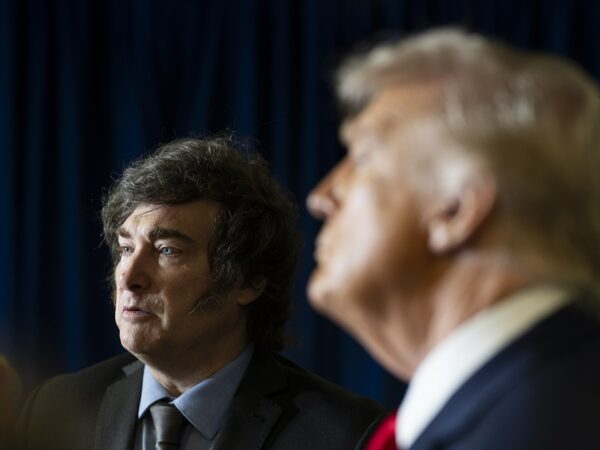
Argentine President Javier Milei, the libertarian who campaigned with a chainsaw and promised to cut his country’s bloated government down to size, is facing a growing problem at home. Voters are souring on him as worries about jobs overtake concerns about inflation.
A new LatAm Pulse survey, conducted by AtlasIntel for Bloomberg News, found that 62% of Argentines now have a negative view of Milei, while 36% view him favorably. In the previous survey, 59% viewed him negatively and 38% viewed him positively.
The slide comes as unemployment has become the top worry for Argentines. Half of respondents ranked joblessness among the nation’s biggest problems, ahead of both corruption and inflation. Only about a third named inflation as a top concern. That is a notable shift for a president who has built much of his message around taming the runaway prices that plagued Argentina for years.
Roughly 70% of those surveyed described the labor market as bad. The formal private sector has lost jobs almost every month since Milei took office in December 2023.
Still, Milei’s political opponents are hardly riding a wave of public enthusiasm. Buenos Aires Province Governor Axel Kicillof, a Peronist widely seen as a likely challenger in the next presidential race, posted a 39% positive rating, up two points. His negative rating held steady at 54%.
Former President Cristina Fernández de Kirchner, who is under house arrest and barred from holding public office, had the highest positive rating in the poll at 41%. Even so, both Kicillof and Kirchner remain broadly unpopular with Argentine voters.
Wall Street has taken notice. Investors have been selling Argentine government bonds, which have been among the worst performers in emerging markets over the past three months. Yields on bonds maturing in 2035, among the country’s most heavily traded, rose above 13% in November after sitting below 9% in July.
Investors are worried about slowing economic growth and about Milei’s reform agenda stalling in Argentina’s Congress.
Developments in Washington are adding to the uncertainty. Democrats’ sweeping victory in the U.S. midterm elections has raised doubts about whether President Donald Trump, a close Milei ally, will provide financial support to Argentina ahead of its next presidential election, as he did before the country’s 2025 midterm vote.
Prediction markets show the same shift. Milei’s odds of winning reelection on Polymarket fell to 43% in November, down from 56% the month before.
Milei came to power promising to overhaul an economy long shaped by Peronist politics, and his administration has made bringing down inflation its signature priority. With Argentines now focused on paychecks and job security, he faces a new challenge: convincing voters that his free-market overhaul can deliver steady work as well as stable prices.