
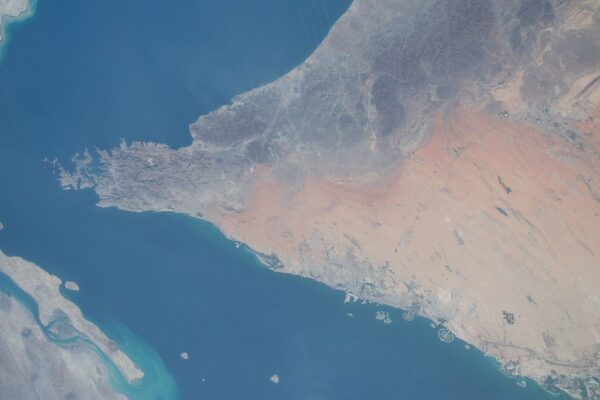
Iran declared Friday that it holds authority over the Strait of Hormuz, warning that safe passage through the strategic waterway can only be guaranteed for vessels that coordinate with Tehran, a statement that comes amid renewed tensions following an alleged drone attack on a commercial ship.
The remarks followed President Donald Trump’s accusation that Iran targeted a commercial vessel sailing near the coast of Oman with a one-way attack drone. According to the British military, the vessel was traveling through a United Nations-approved shipping route at the time of the incident.
Iranian Deputy Foreign Minister Kazem Gharibabadi issued the warning in a post on the social platform X, arguing that ships using the Strait of Hormuz must coordinate with Iran and cautioning that efforts to bypass Tehran’s role could have consequences.
“Safe passage through the Strait of Hormuz, with ambiguous arrangements, parallel routes, or decision-making outside of Iran’s considerations as the coastal state, cannot be guaranteed,” Gharibabadi wrote.
He added that “any credible framework must be based on coordination with Iran and the provisions of paragraph five of the Islamabad Memorandum of Understanding. Otherwise, the outcome will be the suspension of the designated parallel route.”
The statement highlights growing tensions surrounding the Memorandum of Understanding signed between the United States and Iran last week. One provision of the agreement called for the immediate safe passage of vessels through the Strait of Hormuz, with Iran agreeing to facilitate navigation to the best of its ability despite the continued presence of mines in the waterway.
The agreement also sought to prevent Iran from imposing tolls or other fees on commercial vessels for at least 60 days. In addition, the MOU recognized Iran’s right to “define the future administration and maritime services” of the strait through discussions with Oman and other Persian Gulf coastal states.
The United States, however, joined the Gulf Cooperation Council on Thursday in reaffirming that “free, unconditional, and unrestricted navigation,” including the internationally recognized right of transit passage, remains essential to regional and global security.
Iran rejected that position, with its Foreign Ministry pointing to the MOU while asserting that Iran and Oman possess the authority to determine how the strait is administered.
The latest allegations of Iranian attacks on ships traveling through the Strait of Hormuz now represent a significant challenge to the agreement reached between Washington and Tehran on June 17.
That deal had brought substantial relief to global markets by establishing a ceasefire and reopening one of the world’s most critical shipping lanes. The Strait of Hormuz, which carries roughly 20 percent of the world’s oil and natural gas supplies, had been effectively closed for more than three months before the agreement restored commercial transit.
The reported drone strike has also affected humanitarian efforts in the region.
Following the incident, the International Maritime Organization paused plans to evacuate approximately 11,000 stranded seafarers.
IMO Secretary-General Arsenio Dominguez said Friday that he is working with the United States, Oman, Iran and other regional governments to obtain renewed assurances that commercial vessels will not be targeted.
“We’re working to find these guarantees that were provided at the beginning that vessels would not be targeted in that flow of trade … particularly to evacuate the seafarers,” Dominguez said during a virtual briefing at the United Nations.
He added that the evacuation effort would resume once those guarantees are confirmed.
Trump described the alleged drone attacks on Friday as a “foolish” violation of the ceasefire. However, he did not indicate that the United States would reimpose a naval blockade against Iranian vessels, resume U.S. military operations or end ongoing negotiations with Tehran over its nuclear program.
The months-long conflict began after U.S. and Israeli strikes inside Iran in February. The fighting led Iran to restrict travel through the Strait of Hormuz, disrupting global energy markets and driving prices sharply higher. With roughly one-fifth of the world’s oil supply passing through the narrow waterway, the strait remains one of Iran’s most significant sources of geopolitical leverage over both allies and adversaries.