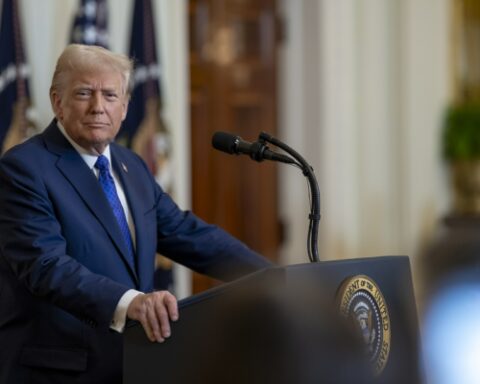


President Donald Trump said Thursday that Chinese President Xi Jinping made a significant commitment during their latest meeting, pledging that China would not provide military equipment to Iran—a development the president described as meaningful amid rising tensions in the region.
Speaking in an interview with Sean Hannity on Fox News, Trump said Xi’s remarks were clear and direct.
“He said he’s not going to give military equipment. That’s a big statement. He said that today,” Trump said, emphasizing the importance of the pledge. At the same time, Trump noted that China’s economic interests remain tied to the region, particularly its reliance on Iranian oil.
“He said that strongly, but at the same time he said they buy a lot of their oil there and they’d like to keep doing that. He’d like to see Hormuz strait opened,” Trump added.
China has long denied allegations that it is supplying weapons to Iran. A spokesperson for the Chinese Ministry of National Defense reiterated that position in recent weeks, pushing back against claims of military support and criticizing what Beijing has described as the spread of false information.
Still, questions persist. According to a report from The New York Times, U.S. officials have indicated that Chinese companies have at least explored the possibility of arms sales to Iran, including discussions about routing such transfers through third countries. While those reports have not resulted in confirmed transfers, they underscore the uncertainty surrounding the issue and the difficulty of separating economic ties from strategic concerns.
Trump’s comments came after a high-level summit with Xi in Beijing, which the White House characterized as a productive exchange. At the center of the discussions was the Strait of Hormuz, a critical global shipping route that has increasingly become a source of tension.
According to a White House readout, both leaders agreed that the strait must remain open to ensure the free flow of energy—a point of rare alignment as geopolitical pressures continue to mount. Xi also expressed opposition to the militarization of the waterway and to any attempt to impose tolls on its use, signaling concern about further escalation in a region already strained by conflict.
The Chinese leader additionally indicated an interest in purchasing more American oil, a move that could reduce China’s reliance on shipments passing through the strait over time. Such a shift, if realized, could ease some of the economic pressure tied to disruptions in the region, though it remains uncertain how quickly or to what extent those changes could occur.
Both sides also reiterated a shared position that Iran should never obtain a nuclear weapon, reinforcing a longstanding point of agreement even as broader tensions persist.
The meeting reflects a complex balancing act. On one hand, there is clear interest from major powers in preventing further escalation and maintaining open trade routes. On the other, ongoing disputes and military posturing continue to cast a long shadow over the region.
While diplomatic assurances like Xi’s pledge may offer a measure of reassurance, they also highlight how fragile the situation remains. With economic interests, security concerns, and competing narratives all in play, even small shifts in policy or rhetoric can carry outsized consequences—especially in a region where prolonged conflict has already proven costly and difficult to contain.
[READ MORE: Wall Street Journal Editorial Warns Iran Believes Trump Lacks Appetite for Long Fight]