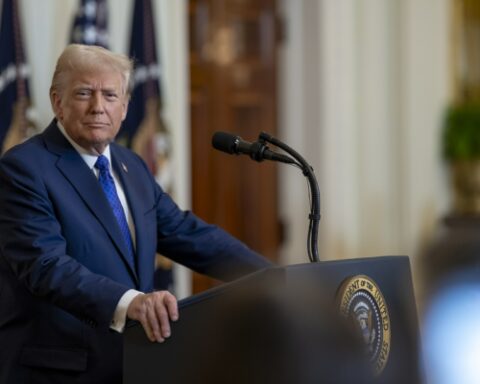


The United Kingdom moved swiftly on Friday to reaffirm its sovereignty over the Falkland Islands after a report suggested the United States may be weighing responses to NATO allies that have not fully backed its military offensive in Iran.
According to Reuters, an internal Pentagon email outlined possible options for reviewing U.S. positions on certain allied territories, including what it described as “imperial possessions.” Among those referenced were the Falkland Islands, a British-administered territory long claimed by Argentina.
British officials responded with rare unity. Foreign Secretary Yvette Cooper stated plainly that the Falklands are British, emphasizing that sovereignty rests with the United Kingdom while the principle of self-determination lies with the islanders themselves. Her remarks echoed a broader sentiment across the political spectrum in London.
Conservative Party leader Kemi Badenoch also dismissed the notion that the status of the islands could be reconsidered, asserting that British sovereignty stands “no matter what” President Donald Trump might suggest. She compared the situation to past comments involving Greenland, signaling skepticism about the seriousness of the reported proposal while still calling for vigilance in protecting British territory, including both the Falklands and the Chagos Islands.
Reform U.K. leader Nigel Farage, a frequent Trump ally, similarly underscored that the Falklands “are and will always be British,” highlighting how the issue has drawn consensus even among figures with otherwise differing political alignments.
A NATO official added another layer of clarity, noting that the alliance’s founding treaty does not include provisions for suspending or expelling member states. That statement comes amid reports that the Pentagon email also floated the idea of suspending Spain from NATO, following Madrid’s decision to restrict the use of its bases for U.S. aircraft involved in the Iran conflict.
Spain’s government sought to calm speculation. Prime Minister Pedro Sánchez said he was “absolutely not worried” about his country’s standing within NATO, emphasizing that Spain remains a reliable member committed to cooperation—so long as it aligns with international law. He also downplayed the significance of the reported email, noting that official policy is determined by formal government positions, not internal communications.
The Pentagon, for its part, defended the administration’s broader stance. Press secretary Kingsley Wilson said the United States expects more from its allies, arguing that partnership should not be one-sided. She indicated the Defense Department is exploring options to ensure NATO partners contribute more meaningfully to shared efforts.
Meanwhile, Argentina reiterated its longstanding claim to the Falklands. President Javier Milei said his government is doing “everything humanly possible” to see the islands returned to Argentine control, underscoring how the issue continues to resonate far beyond Europe.
The backdrop to these developments is an ongoing strain among Western allies over the Iran conflict. President Trump has previously criticized both Spain and the U.K. for hesitating to provide full support, even directing Treasury Secretary Scott Bessent to cut off dealings with Spain and publicly rebuking British Prime Minister Keir Starmer over the proposed transfer of the Chagos Islands to Mauritius.
As tensions rise, the dispute highlights the fragile balance within alliances during times of conflict. While leaders often emphasize unity, differences over strategy and involvement can quickly surface, sometimes spilling into broader geopolitical questions—including territorial sovereignty. In an environment already shaped by military pressure and economic uncertainty, such divisions serve as a reminder that even longstanding partnerships can face strain when the costs of conflict come into sharper focus.
[READ MORE: U.S. Burns Through Weapons Stockpile at Alarming Pace in Iran Conflict]