
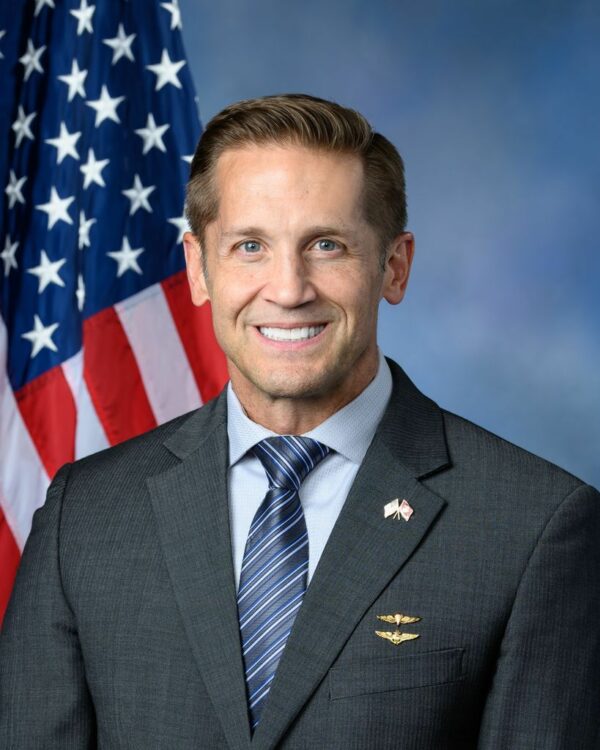
Rep. Rich McCormick (R-Ga.) is breaking with President Donald Trump over a key issue emerging from ongoing discussions surrounding a peace agreement with Iran, making clear that he does not support allowing the Iranian regime to retain ballistic missile capabilities.
Speaking with MeidasTouch on Capitol Hill on Tuesday, McCormick was asked about recent comments from both Trump and Vice President JD Vance regarding Iran’s missile program and the broader question of whether the country should retain some form of military self-defense under a final agreement.
The Georgia Republican, a military veteran with decades of experience, did not hesitate to offer a sharply different perspective.
“I don’t really track what the vice president says, I have my own opinion,” McCormick said. “I’ve been 20 years in the military. I served overseas in the Persian Gulf for a couple tours. I’m a Marine by nature.”
McCormick then laid out his concerns about the government in Tehran, arguing that the regime’s history leaves little room for trust.
“I’ll tell you what I’m not gonna have is a Tehran regime that’s pursuing ballistic missiles, pursuing nuclear arms,” he said. “It says they’re gonna rain down fire from above on the United States. It’s attacked us 40 times, proxy terrorist organizations killed 1,000 people. I don’t really care what they choose to do. I know what we should do.”
His comments place him at odds with Trump’s recent remarks regarding Iran’s missile capabilities following a peace deal.
Last week, Trump raised eyebrows when discussing what a future arrangement with Iran might look like. Asked about ballistic missiles, the president suggested that it could be unfair to deny Iran capabilities that other nations possess.
“I’m saying that if other countries have them, it’s a little bit unfair for them not to have some,” Trump told reporters.
The comments sparked criticism from some observers who pointed to Trump’s much tougher rhetoric at the beginning of the conflict. On the first day of the war, Trump declared that “we’re going to destroy their missiles and raze their missile industry to the ground.”
Those contrasting statements prompted accusations of a policy shift.
Vice President Vance later rejected claims that the administration had reversed course. He argued that Trump’s position remained consistent and stressed that Iran would not be permitted to develop missile systems capable of posing a broad threat.
“You can’t tell a country, whether Israel or Iran, they’re not allowed to have any self-defense. That’s not what the president has asked,” Vance said.
But McCormick remained unmoved.
“Once again, I’m not worried about what the president says or what the vice president’s gonna say because what I have is my own opinion,” he said. “I have very strong feelings about that Tehran regime, which I do not trust, and I would love to see eliminated. That’s my opinion, nobody else.”
He added that his views are rooted in his own experiences and military background.
The disagreement highlights continuing divisions surrounding Trump’s memorandum of understanding with Iran. While administration officials argue that the agreement will reopen the Strait of Hormuz and permanently prevent Iran from obtaining a nuclear weapon, critics from both parties have expressed concerns about several provisions.
Among the issues drawing scrutiny are the easing of oil sanctions on Iran and the framework for a proposed $300 billion reconstruction investment fund. Opponents fear those measures could ultimately strengthen the current Iranian government.
As debate continues, the dispute underscores the difficult balance between pursuing peace agreements and addressing security concerns. Even among Republicans who support a hard line against Tehran, questions remain over what concessions are acceptable in order to prevent future conflict while avoiding another prolonged cycle of instability and confrontation.