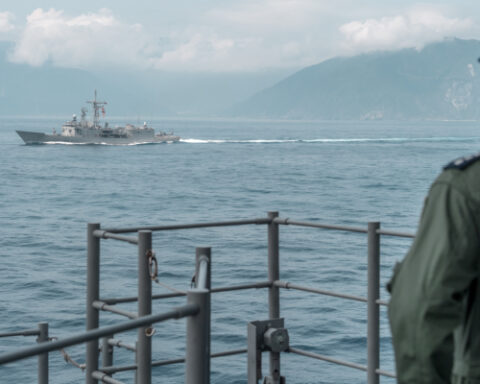

Taiwan President William Lai participated in a major overnight military exercise as the self-governed island continued its annual Han Kuang drills, which are designed to prepare the government and military for potential conflict amid ongoing concerns about pressure from Beijing.
As part of the exercise, Lai was transported from his offices in Taipei to a fortified command center in an armored personnel carrier. The scenario simulated the government’s response to a potential “decapitation strike,” a military operation aimed at disabling Taiwan’s leadership during a conflict.
Video released by Taiwan’s Presidential Office showed Lai arriving at the secure facility wearing a flak jacket before receiving briefings from officials and issuing instructions as the exercise unfolded. The operation, known as “Wan Chun,” is intended to rehearse the evacuation of Taiwan’s president during war or another national emergency while ensuring the government can continue functioning throughout a crisis.
Presidential spokeswoman Karen Kuo said the exercise was designed to evaluate Taiwan’s emergency preparedness at multiple levels of government.
“The drill was intended to review the command structure, inter-agency coordination, and emergency-response mechanisms, so as to ensure that the government can continue operating effectively and safeguarding national security,” Kuo said.
The exercises come as tensions between Taiwan and China remain elevated.
Beijing claims the self-governed island as part of its territory despite never having ruled it and has repeatedly pledged to bring Taiwan under its control. Chinese President Xi Jinping has not ruled out the use of force to achieve what Beijing describes as “reunification.”
Alongside the drills, China has continued military activity around Taiwan by regularly sending warships and military aircraft into surrounding areas while conducting what it describes as patrols and military exercises. The report also notes that previous images have shown mock-ups of Taiwan’s Presidential Office and other government buildings constructed in the Chinese desert for training purposes.
Taiwan has mobilized approximately 20,000 reservists for this year’s Han Kuang exercises. The drills include practicing the defense of key infrastructure such as ports, power stations, and bridges across the island. Troops have also rehearsed defending the strategically important Danjiang Bridge while Patriot missile systems and Taiwan’s domestically produced Tien-Kung air defense systems have been deployed in various locations.
In addition to military exercises, Taiwan plans to deliberately slow its mobile internet network next week as part of a communications resilience test during a simulated national emergency. A senior defense official said the drills are no longer viewed as a “lab-like exercise in a vacuum,” reflecting what officials see as increasing security concerns as tensions with Beijing continue.
According to the report, the Wan Chun exercise is conducted as part of Taiwan’s 10-day Han Kuang military drills, the island’s largest annual military exercise involving both military personnel and civilians. It also marks the first known time Lai has participated in the Cold War-era contingency exercise since taking office in 2024, although previous presidents Tsai Ing-wen and Ma Ying-jeou also took part during their administrations. The evacuation plan itself was originally developed during the Cold War amid concerns that Taiwan’s leadership could be targeted during a military conflict.