
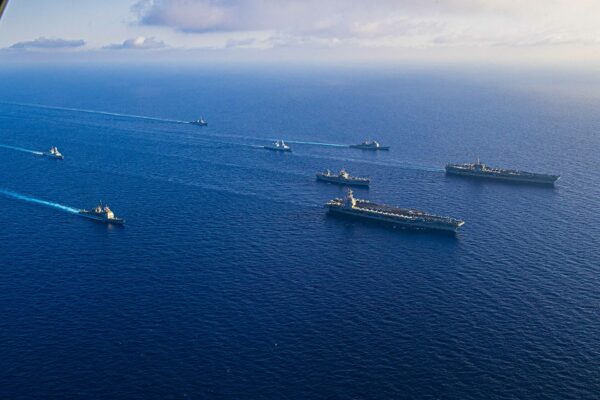
The USS Abraham Lincoln aircraft carrier has reportedly entered U.S. Central Command waters in the Indian Ocean as tensions with Iran continue to rise, according to a senior U.S. official who spoke to Fox News on Monday.
The deployment comes amid growing signs of instability inside Iran and mounting concerns that the regime could be preparing for military action. Reports indicate that Iran’s Supreme Leader Ayatollah Ali Khamenei has gone underground, a move often interpreted as a signal of heightened threat levels or anticipation of conflict.
While the carrier’s presence underscores Washington’s intent to project power and deter aggression, the senior U.S. official cautioned that the Abraham Lincoln is not yet positioned or prepared for any potential strike operations against Iran. Instead, the move is part of a broader effort to reinforce the U.S. military posture in the region as the situation continues to evolve.
Experts warn that Iran poses a unique and dangerous threat to U.S. naval assets, particularly through its expanding use of unmanned aerial systems. Cameron Chell, CEO and co-founder of drone manufacturer Draganfly and a leading expert in drone warfare, told Fox News that Iran has developed what he described as an effective asymmetric strategy designed to challenge even the most advanced military platforms.
According to Chell, Iran has paired low-cost warheads with inexpensive drone delivery systems, allowing it to deploy large numbers of unmanned aircraft at once. Those swarms, he said, could overwhelm traditional naval defenses that were not designed to counter mass, simultaneous aerial attacks.
“If hundreds are launched in a short period of time, some are almost certain to get through,” Chell said.
He explained that modern defense systems aboard warships were primarily built to counter a limited number of high-end threats, not large volumes of relatively unsophisticated drones attacking at once. For U.S. surface vessels operating near Iran, that reality creates a serious vulnerability.
“Modern defense systems were not originally designed to counter that kind of saturation attack,” Chell said. “For U.S. surface vessels operating near Iran, warships are prime targets.”
U.S. officials say Washington is responding to the growing instability by reinforcing its presence across the region. In addition to the Abraham Lincoln’s movement into CENTCOM waters, the United States has boosted its military footprint by air, land, and sea. A squadron of F-15 fighter jets has deployed to the region, and C-17 transport aircraft carrying heavy equipment have also arrived.
At the same time, U.S. forces are closely monitoring developments in neighboring Syria, where instability could further complicate the regional security picture.
Chell noted that while the U.S. and its allies are rapidly developing new defensive capabilities to counter drone threats, questions remain about how effectively current systems aboard carrier strike groups can handle coordinated drone formations launched in large numbers.
He emphasized that Iran’s drone fleet represents one of the most serious challenges facing U.S. naval forces in the region.
“These drones give Iran a very credible way to threaten surface vessels,” Chell said. He added that U.S. military assets are often large, slow-moving, and easily identifiable on radar, making them especially vulnerable to attack.
“Iran’s strength lies instead in these low-cost, high-volume drone systems — particularly one-way strike drones designed to fly into a target and detonate,” Chell said.
As tensions with Tehran continue to build, the arrival of the USS Abraham Lincoln highlights both America’s military reach and the evolving nature of modern warfare, where inexpensive technology can pose outsized risks to even the world’s most powerful naval forces.
[READ MORE: Trump Administration Considers Oil Blockade as Pressure Mounts on Cuban Regime]