

Secretary of War Pete Hegseth declined to directly answer a question Friday about whether the United States might send troops into Iran to seize its stockpile of enriched uranium, underscoring the uncertainty surrounding the next phase of the ongoing military campaign.
The question came during a press exchange with reporters as the Trump administration continues its Operation Epic Fury, the military effort launched after negotiations aimed at stopping Iran’s nuclear ambitions broke down earlier this year.
President Donald Trump announced the operation in a video posted to Truth Social early on Feb. 28, saying the decision came after diplomatic attempts to halt Iran’s pursuit of nuclear weapons failed.
During the briefing, Wall Street Journal reporter Michael Gordon pressed Hegseth on what would ultimately happen to Iran’s existing nuclear materials.
“Iran is thought to have 440 kilograms of highly enriched uranium in at least two locations and several thousand kilograms of lower purity material,” Gordon said. He then asked whether the United States could truly consider the mission successful without physically securing that uranium, or whether the administration was counting on diplomacy to ensure it is removed or controlled.
Gordon also pointed out that previous administration comments had focused on destroying Iran’s missiles, drones and military infrastructure, but had not clearly stated whether taking control of the nuclear material itself was a direct military objective.
Hegseth avoided outlining any specific plan.
“We’ve said from the beginning, denying Iran nuclear weapons is a core mission,” the defense secretary said. “We have, we retain options across the spectrum to ensure that they never do.”
He emphasized that President Trump has consistently kept the focus on preventing Iran from developing nuclear weapons capability, though he declined to elaborate on what specific steps might be taken next.
The secretary also referenced an earlier phase of the operation that targeted Iranian nuclear facilities. U.S. forces struck sites in Fordow, Natanz and Isfahan on June 21 in an operation designed to damage key elements of Iran’s nuclear program.
The attack involved the use of as many as 14 GBU-57 Massive Ordnance Penetrator bombs. Seven B-2A Spirit stealth bombers carried out the mission during a flight that lasted roughly 37 hours.
According to Hegseth, those strikes were a crucial step that made subsequent military actions possible.
“Without what those B-2s did going across and obliterating those facilities, that set the condition for the opportunity to do what we’re doing now,” he said.
Still, the question of Iran’s remaining nuclear materials remains unresolved. Hegseth suggested that several paths remain possible, including diplomatic ones.
He said the United States has a “range of options,” including the possibility that Iran could ultimately decide to give up the nuclear material voluntarily.
“That of course we would welcome,” he said, noting that Iran had previously rejected such an outcome during negotiations.
At the same time, Hegseth made clear he would not publicly outline potential military plans.
“I would never tell this group or the world what we’re willing to do or how far we’re willing to go,” he said. “But we have options for sure.”
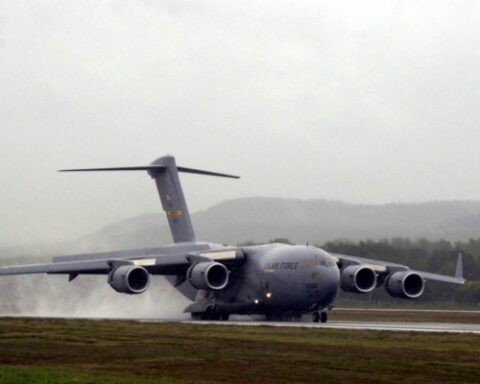
The ongoing operation has come at a growing cost. United States Central Command confirmed that four crew members died Thursday when a Boeing KC-135 Stratotanker crashed in western Iraq.
Additional casualties have occurred since the start of Operation Epic Fury. Six American service members were killed in an Iranian attack on an operations center in Kuwait, while a seventh died from wounds suffered during an Iranian strike on a U.S. base in Saudi Arabia.
Another American service member has died from a medical incident during the course of the operation.
The losses serve as a sobering reminder that even limited military campaigns can carry heavy consequences, particularly when conflicts expand across multiple countries and theaters. As the mission continues, questions remain not only about how the operation will end, but also about how far the United States may ultimately go to ensure Iran never develops nuclear weapons.
[READ MORE: Stephen Miller Declares ‘Complete Wipeout’ of Iran’s Military Capabilities as Conflict Continues]