

A new dispute between the Trump administration and Canada erupted this week after the Pentagon announced it was suspending participation in a long-standing joint defense board with America’s northern neighbor, fueling concerns about growing strain in one of Washington’s closest alliances.
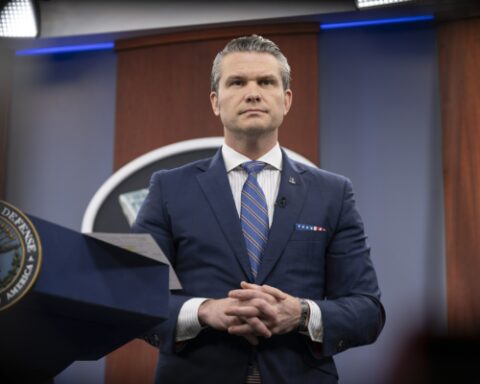
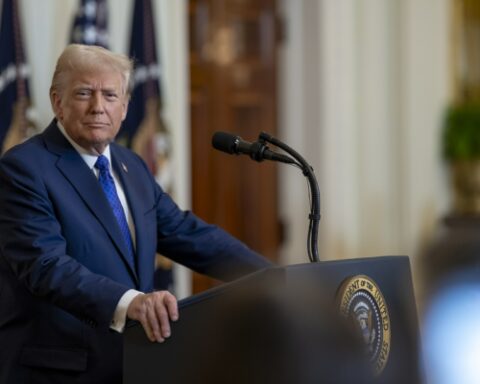
The decision, announced by Pentagon policy chief Elbridge Colby, marked another flash point in the increasingly tense relationship between President Donald Trump and Canadian Prime Minister Mark Carney.
While Carney attempted to downplay the significance of the move Tuesday, many in Canada viewed it as a pointed warning from Washington as Ottawa explores reducing its military dependence on the United States.
“I think it’s a symbolic blow from a Canadian sense,” said David Perry, president of the Canadian Global Affairs Institute. He also suggested the dispute should serve as a wake-up call about how both countries have treated long-standing defense cooperation forums.
The suspended body, known as the Permanent Joint Board on Defense, dates back to World War II. The board was created to facilitate high-level military and civilian consultation between the United States and Canada on issues of mutual concern. It traditionally meets once a year.
In announcing the suspension, Colby criticized Canada for what he described as insufficient investment in military modernization. He also pointed to remarks Carney made at the World Economic Forum in January, where the Canadian leader called on “middle powers” to form a united bloc capable of counterbalancing global superpowers.
Carney responded by highlighting Canada’s recent defense spending increases. He noted Tuesday that Canada is now spending 2 percent of its gross domestic product on defense for the first time since the fall of the Berlin Wall in 1989. That spending includes a $40 billion investment into the North American Aerospace Defense Command, the shared early-warning defense system designed to detect foreign threats approaching North America.
“I mean, it has a long heritage,” Carney said of the defense board, “but I wouldn’t overplay the importance of this.”
Defense analysts in Canada largely agreed the practical consequences of the suspension would likely be limited because both countries maintain numerous other military communication channels. Still, several warned that the episode reflects a broader deterioration in U.S.-Canada relations at a time when Arctic security and global instability are becoming increasingly important.
Andrea Charron, director of the Center for Defence and Security Studies at the University of Manitoba, argued the suspension was likely intended more as a political signal than a major strategic shift.
“If you’re going to send a message and call a hiatus to an advice-giving board, this is a good one to do it, because it’s really not going to have big consequences,” she said.
Charron also speculated that Trump’s frustrations surrounding the war in Iran and what he sees as insufficient allied support could be contributing to tensions with Ottawa. Her comments reflected broader unease among some analysts that foreign conflicts are straining alliances that have historically remained stable even during political disagreements.
Trump and Carney have clashed on several fronts in recent months. Carney campaigned on standing up to Trump and promoting Canadian self-reliance, while Canada has moved to diversify defense partnerships beyond the United States. Ottawa turned to Australia for a major Arctic radar project and is reviewing a purchase agreement for U.S.-made F-35 Lightning II aircraft while considering Swedish alternatives.
Despite the tensions, experts stressed that the United States remains Canada’s most important strategic relationship. Perry argued that Washington’s move may also reflect frustration that Canada has not fully utilized forums like the defense board to strengthen cooperation on shared priorities.
At the same time, Canada’s push for higher military spending carries political and economic challenges at home. Carney has pledged to increase defense spending to 3.5 percent of GDP by 2035, still short of Trump’s 5 percent goal for NATO members.
Imran Bayoumi of the Atlantic Council said achieving that target would likely require difficult trade-offs involving domestic spending priorities and social programs.
For now, Canadian officials appear eager to avoid escalating the public feud. But analysts warned that continued political sniping between allies ultimately weakens both countries at a time when geopolitical tensions are already running high.
“None of this political rhetoric serves anyone’s purposes but China and Russia,” Charron said.