
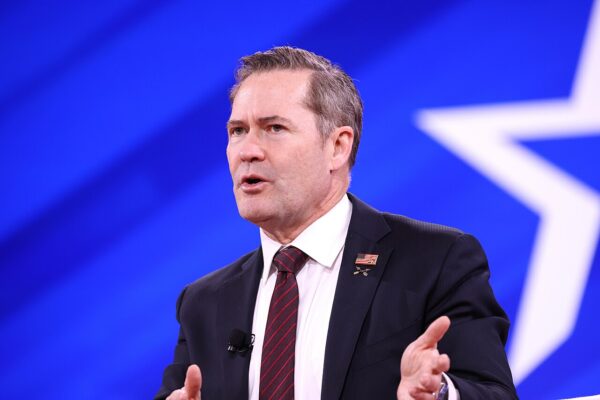
The war with Iran could drag on for another year, according to U.S. Ambassador to the United Nations Mike Waltz. The warning came Friday as oil prices hit their highest level of the conflict and Tehran claimed new attacks on shipping near the Strait of Hormuz.
In an interview with the Financial Times published Friday, Waltz said the U.S. could still be fighting 12 months from now, a war President Donald Trump initially said would last “four to five weeks.”
Waltz said the U.S. will not have achieved its key goals until Iran gives up its highly enriched uranium and accepts a “meaningful agreement on their domestic enrichment.”
“I’m not going to put out hypotheticals. One would hope that they’ll come to the table in a meaningful way before that,” Waltz said.
He added that the president “and the U.S. Navy can maintain this blockade for the foreseeable future,” and said the administration is still tightening its economic pressure campaign on Tehran.
As he left the White House on Friday for a rally in Florida, Trump struck a confident tone.
“Iran is not able to do much now. And we could, if we wanted to, just take all of the oil,” Trump said. “We could take the whole country. And as you know, the Hormuz Strait is ours, and that’s the way we’ll keep it.”
Asked about Waltz’s timeline, the president said the U.S. could end the war quickly but may not need to. “The question is, ‘Do we want to finish it off or do we just want to let it wither?’ Because we’re getting everything we wanted,” Trump said.
Another administration official left open the possibility of military action within days. Tom Barrack, the U.S. ambassador to Turkey, who has no direct role in Iran policy, was asked by Israeli army radio whether there could be a strike this weekend. “Absolutely,” he said, adding that Trump remains “open and available and accessible to a deal.” Trump had earlier said there would be no strikes before the Nov. 3 midterm elections.
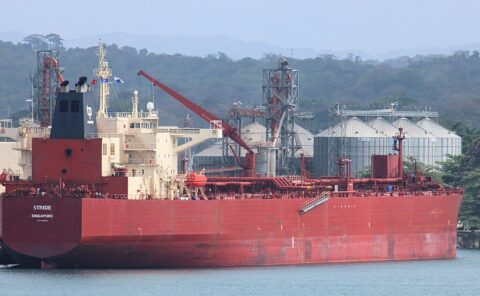
Energy markets are feeling the strain. Brent crude briefly crossed $117 a barrel Friday after Iran’s Revolutionary Guard claimed to have disabled seven tankers near the strait. Brent has surged from under $97 at the start of October. On Wall Street, the Dow fell roughly 550 points by late morning as rising oil prices weighed on stocks.
Trump has accused Iran of fabricating the attacks. “Iran is doing everything they can to drive up the price of Oil prior to the U.S. Midterm Election,” he wrote on Truth Social Thursday. “They are even making up fake hits, mines, and everything else.” None of the Iranian claims have been independently confirmed.
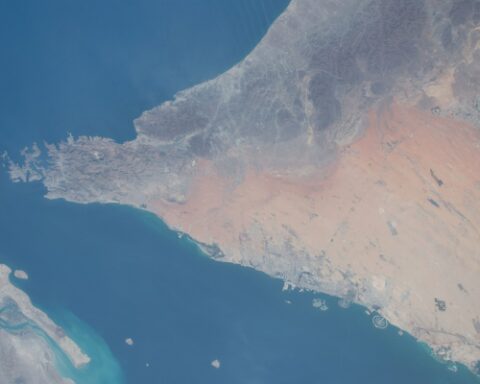
Iranian state TV claimed Friday that all movement of “non-compliant” vessels through the strait had been completely halted. Iran demands that ships seek its authorization and use a northern route near its coast, while the Trump administration has urged shippers to use a southern route near Oman. Before the war, about 20% of global oil supplies passed through the strait.
The United Arab Emirates reported an oil spill affecting beaches in Umm Al Quwain on Friday. Analysts linked it to a tanker struck by a projectile off the UAE coast on Oct. 9.
Gulf allies are adapting. Saudi Aramco said oil flowing through its East-West pipeline, which bypasses the strait, has more than tripled from 2 million to 7 million barrels per day.
In Istanbul, foreign ministers from Britain, France, Germany, Italy, Turkey, Saudi Arabia, Pakistan and Egypt urged restraint and the reopening of the strait. French Foreign Minister Jean-Noel Barrot warned that further escalation “would create nothing but losers.”
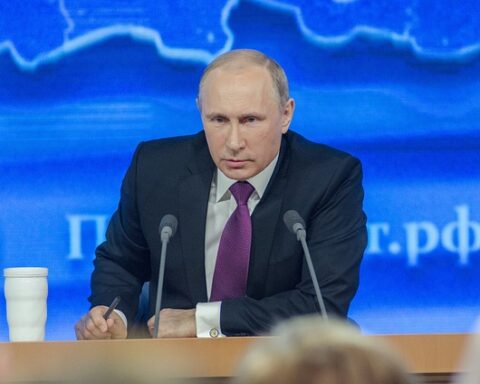
Meanwhile, Iranian President Masoud Pezeshkian is set to travel to Moscow next week for talks with Russian President Vladimir Putin.